

Regulatory developments described here are current as of October 12, 2026.
We hosted our Overview Longevity Summit last month and had a series of terrific discussions led by Dr. Carl Seger who is Bryan Johnson’s doctor and Chief Medical Officer of Immortals and Dr. Omri Drory who is General Partner at NFX leading their biosciences investing. One major takeaway was that peptides are a topic of fascination across the health and longevity spectrum, whether from heavy adopters or those only vaguely aware of them. What struck me most was how hard it is for anyone, even experienced users, to know where these compounds actually come from. It is important for users and providers to understand that a prescription, an FDA registration, and a purity report don’t add up to a trustworthy supply chain.
I myself have been doing deep due diligence on the peptide space across regulatory, supply chain, fulfillment, and consumption for both personal and professional reasons. As a class, peptides have been around a very long time and include household names like oxytocin and the GLP-1 drugs (insulin was previously considered a peptide before the definitions changed). But demand for unapproved peptides, as well as unapproved versions of approved drugs, has given rise to a substantial gray market.
Across consumers, investors, operators, and providers there is a consistent lack of understanding of the dynamics at play and the risks being taken in this gray market. This is not to say there is anything inherently wrong with the manufacturing and consumption of peptides. It is to say that all market participants would benefit from greater transparency and understanding of the systems involved in delivering these products.
How Big Is This Market?
Consumer interest has been fueled by the rise of approved GLP-1 drugs (Mounjaro, Zepbound, Ozempic, and Wegovy alone sold roughly $68B in 2025), which is far and away the lion’s share of the market. But the gray market is growing fast.
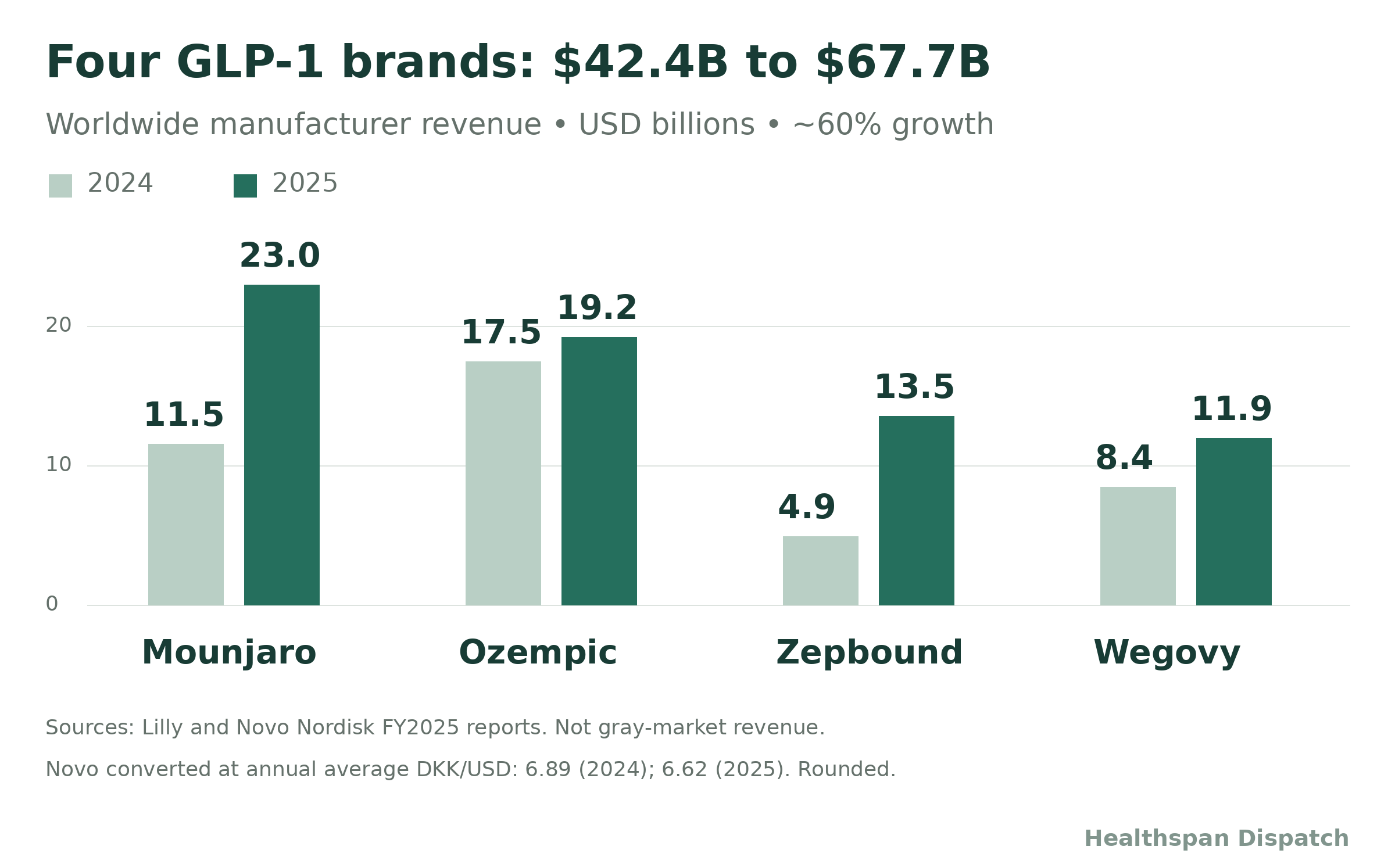
While there is substantial data on the market for approved drugs, no one has a reliable measure of this gray market’s size, but there is reason to take billion-dollar estimates seriously. Forbes reported in July that the illicit peptide market could be worth roughly $3B.
The harder data capture only part of the trade, but give a sense for growth rates. Chainalysis found that cryptocurrency payments to the gray-market peptide vendors it tracked rose roughly 30x from 2024 to Q1 2026. That does not capture card or bank payments, or vendors outside its identified network. Nor does it tell us how much of the money is wholesale versus final consumer spending.
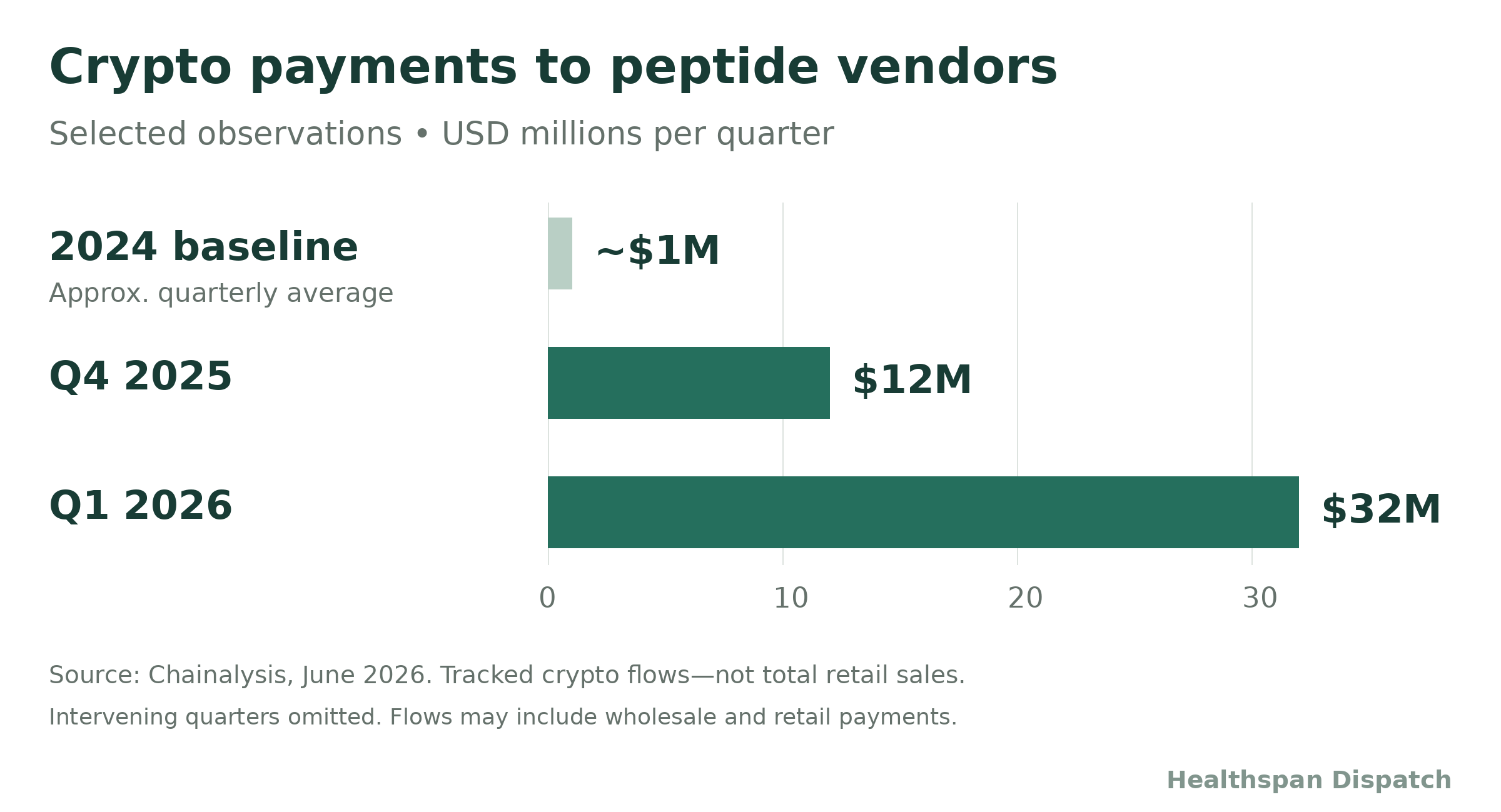
What is missing is a transparent accounting of who is selling how much, through which channels, and at what margins. That lack of visibility is part of the problem and it is partly driven by the opaque regulatory landscape.
Why Does The Regulatory Landscape Matter?
There are consumers that want peptides and manufacturers that want to sell peptides to them. Why should any regulations beyond that matter?
My generally libertarian ethos (and that of many consumerization of healthcare trends) would suggest that two informed market participants should be entitled to do what they want so long as they do not intentionally/recklessly/negligently harm each other or 3rd parties. However, the wheels of commerce are kept well-oiled by high trust systems, and the key part of that previous sentence is informed market participants.
A common set of rules for how a class of goods is made lets everyone along a supply chain, up to the end user, have faith about certain basic tenets. When that chain does break down, there is a common understanding about who is at fault.
The libertarian answer is that markets can build their own trust, and the gray market has tried: buyers pay independent labs like Janoshik & Finnrick to test what they bought. But that system is weakening just as the market goes mainstream, and the consumers are not aware of the fact that the QA burden has been handed off to them. Chainalysis estimated that crypto-funded independent testing spending per buyer fell 88%, to about $8, as the market shifted from early adopters to the mainstream surge beginning in late 2025. That does not capture all testing, but it raises a real question about how many buyers are independently checking what they buy.
In America, for things people put in or on their bodies, the basic rules of the supply chain are governed most prominently by the FDA. These rules and regulations are not perfect by any means, but they provide clarity, reinforce duties of care, and maintain accountability.
Gray market peptides can arrive through the same pharmacies, clinics, storefronts, and e-commerce experiences as regulated products, without the consumer understanding which rules apply—or whether they are being followed.
An FDA-approved drug, a compounded preparation, and a research-use-only vial are not interchangeable, even when they contain the same molecule. Compounding can be legitimate when applicable conditions are met, but neither a prescription nor the molecule’s presence in an approved drug is sufficient by itself. Compounded drugs are not FDA-approved.
So how does this market scale develop out in the open despite no legal framework?
The whole gray market only exists because federal enforcement priorities and federal agency resource allocation allow it – not because there are any current safe harbors or legitimate exceptions that allow their sale for human or animal consumption.
Generally speaking, unless there is evidence a vendor has harmed someone or included other regulated substances (like SARMs or hormones) in their product, or committed fraud, the feds have demonstrated that they aren’t going to pursue enforcement action against sellers beyond issuing an FDA warning letter. Another enforcement mechanism is at the border: on September 5, 2025 the FDA launched a “green list” of foreign GLP-1 manufacturers under Import Alert 66-80, letting its field staff detain GLP-1 shipments from anyone not on it. Seized shipments may become an interesting future indicator of the size of these markets.
Where is the Product Coming From?
The three principal paths to market for gray-market peptides are the Research Use Only (“RUO”) sellers, compounding pharmacies, or oral supplements. In most cases, the Active Pharmaceutical Ingredient (“API”) is coming from Chinese manufacturers (and to a much lesser extent Indian or European manufacturers).
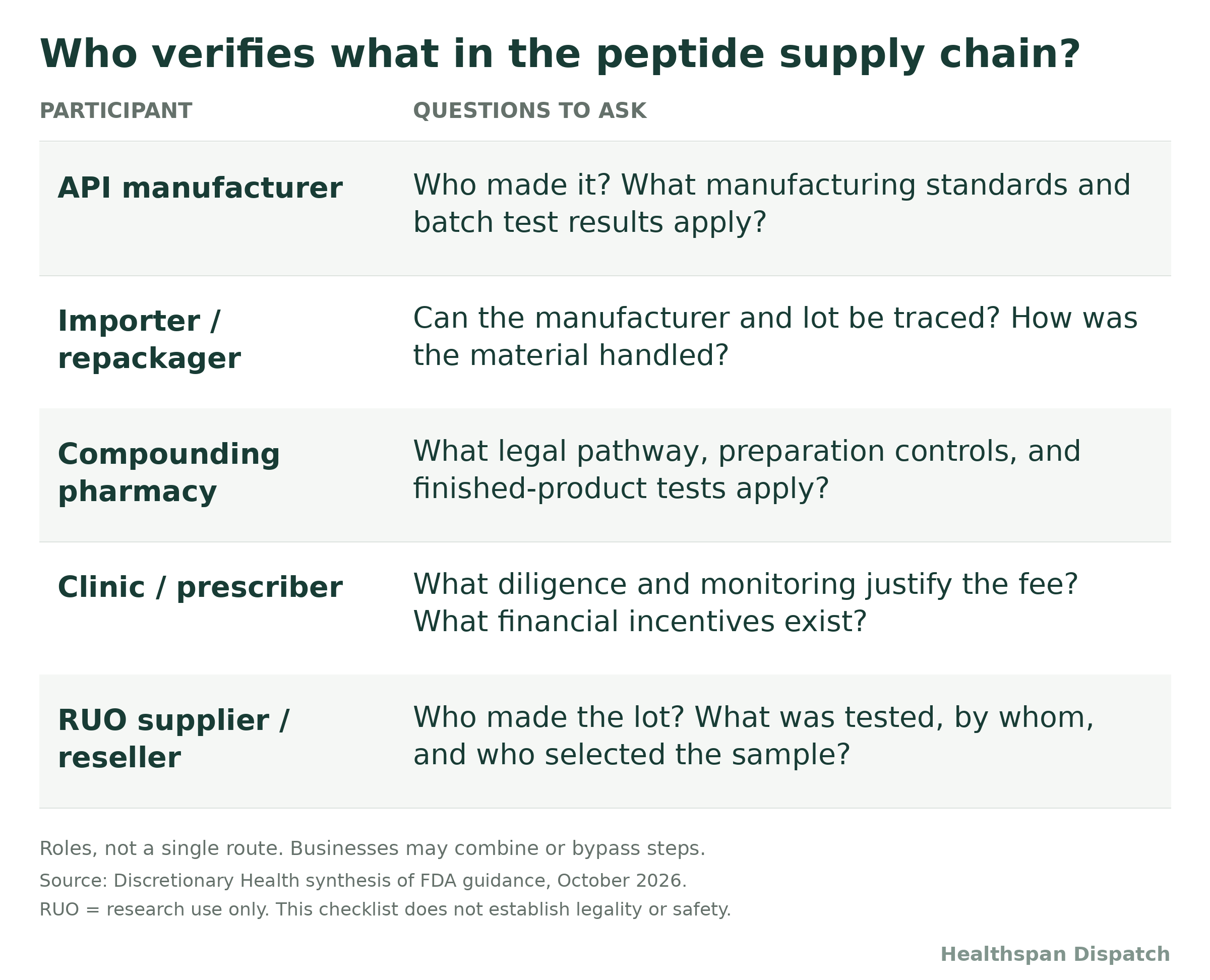
Coming from China is not the issue, it is the variability and lack of transparency that is. The important questions are who manufactured it, to what standard, and who verified it along the way.
The RUO crowd purports to be selling the compounds not for human or animal consumption but for some sort of research; this is a thin semantic barrier with no real legal protection whatsoever. Compounding pharmacies are legally required to buy API from FDA-registered facilities (though compliance may vary), meet sterility standards, and pass state inspections, which is more than RUO sellers face. But a provider prescription does not by itself make a gray market peptide more credible or say anything about the supply chain it came from.
For products marketed as oral supplements, putting a peptide in a capsule does not itself make it a legitimate dietary ingredient. Dietary ingredient eligibility and restrictions involving approved or investigational drugs still matter. Outside of a few simple peptides already found in food, like collagen peptides or carnosine, the synthetic peptides sold in this market don’t qualify as supplements.
Whether the API is coming from China or anywhere else, there is a major supply problem for many of the unapproved peptides. Scott Brunner, CEO of the Alliance for Pharmacy Compounding, has warned that, to his knowledge, the only API available for many of these peptides is research grade, rather than pharmaceutical grade. Research-grade material does not by itself establish the manufacturing controls, validated testing, traceability, and release specifications required for pharmaceutical use. A high purity number is not a substitute for those systems. Skipping that work can lower upfront costs, but this is really shifting the vetting burden downstream to a compounding pharmacy, provider, or individual purchaser of the compounds. Testing downstream cannot fully replace manufacturing controls upstream. Doing neither creates peril for all parties.
Types of Gray-Market Peptides
Across this market, the compounds generally fall into three groups:
Unapproved versions of approved drugs. These include products containing semaglutide, tirzepatide, tesamorelin, and PT-141. Their sale must be distinguished from both the approved products and preparations compounded in compliance with applicable requirements.
Unapproved trial drugs. This is a popular category headlined by the investigational drug retatrutide. As data get released about promising trials, consumer demand increases and gray market supply follows. Consumers try to front run compelling new drugs that are easily replicated and not yet approved.
Unapproved “wellness” peptides. These include BPC-157, TB-500, MOTS-c, and others marketed for recovery, longevity, or performance. Those are promoted uses, not established benefits. A subset is being considered by the FDA for addition to the 503A Bulks List.
The promise of these various peptides generally falls into the following categories:
Weight Loss/Metabolic (largest by far): retatrutide, tirzepatide, semaglutide, cagrilintide, survodutide, AOD-9604
Recovery & Tissue Repair: BPC-157, TB-500, KPV, GHK-Cu
Growth Hormone & Body Composition: CJC-1295, ipamorelin, sermorelin, tesamorelin, GHRP-2/6, IGF-1 LR3
Longevity & Mitochondrial Support: epitalon, MOTS-c, SS-31, humanin, FOXO4-DRI
Cognitive, Sleep, and Mood Enhancement: semax, selank, DSIP, dihexa
Sexual & Aesthetic Enhancement: PT-141, melanotan II, kisspeptin, GHK-Cu
Immune Boosting: thymosin alpha-1, LL-37, KPV
GHK-Cu and KPV appear in two categories because they are used for both.
Are There Paths to Regulatory Legitimacy?
There has been a lot of attention paid to Secretary Kennedy at HHS and the MAHA movement being pro-peptide, and in July the FDA’s Pharmacy Compounding Advisory Committee reviewed 7 of the most popular gray-market peptides and voted to recommend adding 6 of them, including BPC-157, to the Bulks List. Those votes are non-binding and still require FDA sign-off. (I’ll go deeper on 503A vs. 503B compounding, the Bulks List, and where the regulatory landscape is headed in a future post; for now think of potential addition to the Bulks List as the main legitimate path for compounding pharmacies to sell these molecules).
On October 7, the Washington Post reported that HHS is preparing a temporary stopgap on this same track: while the FDA writes the formal rules, compounding pharmacies would be allowed to dispense some of these previously restricted peptides now, possibly through “enforcement discretion,” where the FDA says it will focus its enforcement elsewhere. Which peptides would qualify, and when, has not been announced. The plan is reported but contested inside FDA: Pink Sheet reported on October 8 that FDA drug-review staff won’t recommend the stopgap, citing patient safety concerns.
A Bulks List change and enforcement discretion are not the same thing. One can change eligibility for compounding under specified conditions; the other describes how the FDA intends to use its enforcement resources. Neither is FDA approval of the resulting product.
A legitimate path to compounding should unlock meaningful investments in supply chains and more incentives for transparency because market participants will no longer be operating in the shadows. But this will not happen overnight, and a legal path to sale is not, by itself, proof of quality.
The Consumer Reality
These dynamics lead to a tough situation for consumers. Oversight exists, but the consumer often cannot see what has actually been inspected or tested—or what happened when something failed.
In its July briefing, FDA staff cited only three adverse event reports for BPC-157, but few reported adverse events are not evidence of safety. Reporting obligations vary, and 503B outsourcing facilities must report adverse events to the FDA, but most peptide compounding happens at 503A facilities, which face no comparable federal requirement, and RUO sellers face none at all. For an unregulated market this size, there has been remarkably little personal-injury litigation. Most lawsuits so far have come from Novo Nordisk and Eli Lilly protecting their brands, not from injured consumers, and the few injury suits against compounders have struggled in court. But a lack of reports and lawsuits does not, on its own, establish a reliable supply chain.
The consumer’s assumption should be that they are looking at a very shady supply chain for gray market peptides unless proven otherwise - whether it comes from a pharmacy or a RUO seller.
Many compounding pharmacies will say something generic like “we only purchase our API from FDA-registered providers.” This is a legal sourcing requirement, not a differentiator. An FDA-registered facility is self-registered; it does not mean that the FDA has approved the firm or any of its products - it is self-reporting paperwork any overseas operator could file. It should be considered a necessary but insufficient condition of a reliable peptide supply chain.
The important thing for the consumer is that whoever is importing, compounding, or prescribing the API is undertaking or verifying a real QA process. This includes testing against defined specifications, holds on batches until results come back, and an actual willingness to reject a batch if it does not meet those specifications.
Testing the API is not the same as testing the finished injectable product. A purity report alone does not establish sterility, absence of endotoxins, or safety for human use. The laboratory’s competence, methods, independence, and sample traceability matter more than its address.
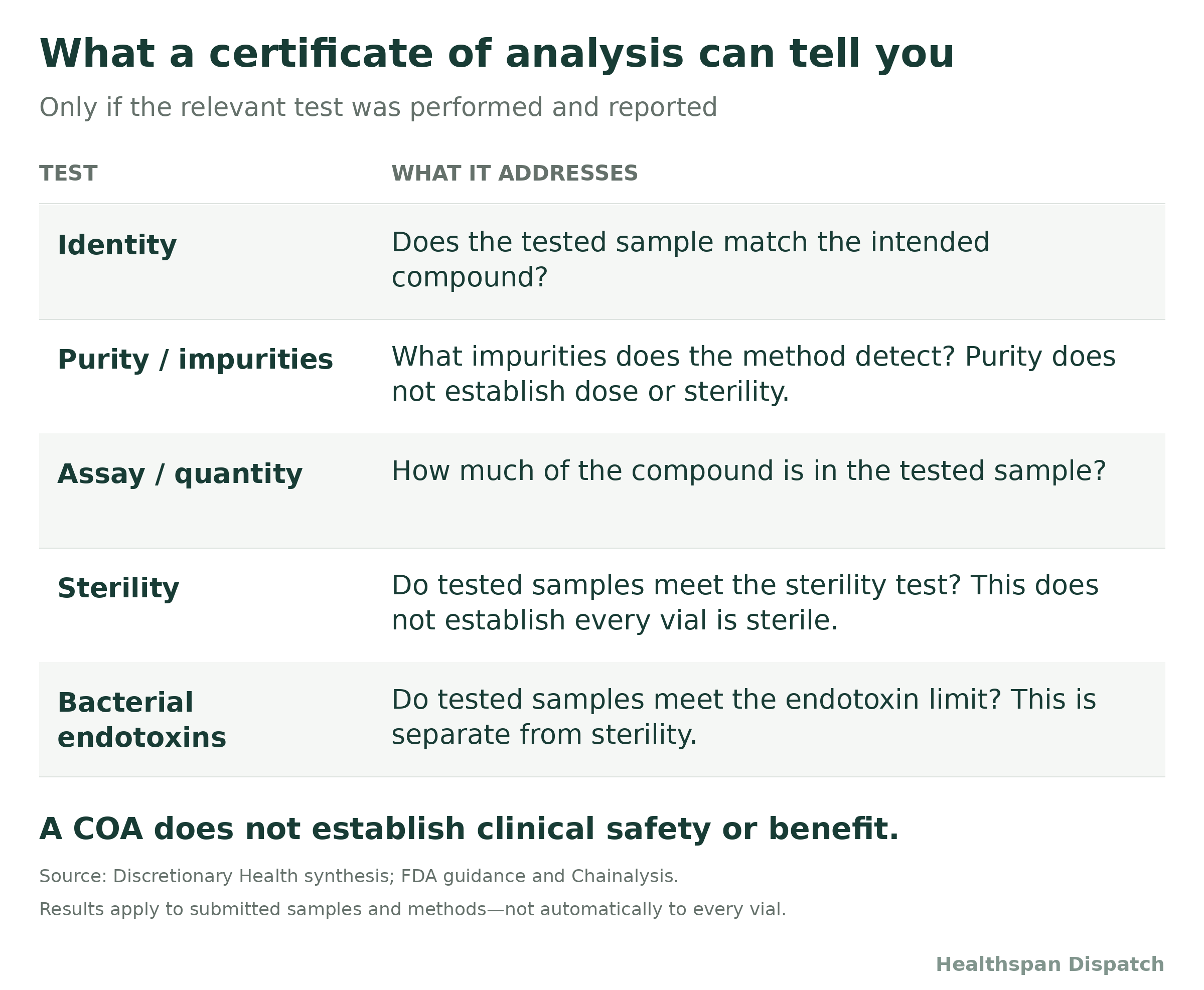
No doubt there are some parties that are doing this work, but the question is who?
There is a clear incentive not to be too promotional about one’s rigorous QA operations. For RUO it could be seen as further evidence that the product is in fact for human consumption. For compounding pharmacies selling products that are either illegal or do not meet applicable requirements, promotion could also draw scrutiny. Providers who partner with compounding pharmacies should be vetting the QA processes themselves. Whether they do so is functionally invisible to the consumers injecting these compounds into their bodies.
Who Gets Paid - And For What?
Some peptide arrangements between compounding pharmacies and private clinic providers involve incentives that are hidden from the consumer. Depending on the arrangement and the state, these can raise questions under kickback and patient brokering laws. A markup alone does not establish a violation.
Consumers should ask their provider directly: Do you earn anything on the peptides you prescribe, and from whom?
If providers are not compounding the peptides, taking inventory risk, or even vetting the supply chain, they are essentially acting as facilitators for products that their customers might be better off buying in the direct to consumer RUO market.
Clinics marking up peptide sales without doing any due diligence are engaged in the kinds of practices that are terrible for the industry and the consumer. Holding all participants accountable to verifiable supply chains is the best way to ensure consumers are served and the whole industry avoids heavy handed regulation.
Private pay clinics should be free to pursue their business models however they see fit, but taking gray market peptide margin while not doing any QA review is a practice that reflects either a misunderstanding of the current state of the peptides market or a prioritization of easy profits over patient wellbeing.
How Can Consumers Protect Themselves?
A savvy consumer can absolutely navigate this space, but it is best to approach it with a high degree of skepticism and diligence. Ask for an independently verifiable COA that matches the lot number on your vial, check what was actually tested, and ask your provider what they earn on what they prescribe.
These steps can expose gaps. They cannot establish that a compound is safe or effective for you.
Visiting facilities and reviewing quality processes should be responsibilities that belong to the clinics and RUO sellers. Consumers should not have to reconstruct the supply chain themselves, but in many cases still need to if they want maximum transparency.
What This Means for Clinics and Investors
Clinics carry the patient relationship and the liability, so this work should be done before the first script and repeated.
What to ask your compounding partner:
Who manufactures your API? For GLP-1 APIs, do the manufacturer and product appear on the applicable FDA green list?
What is tested before a batch is released? Can I see results matched to lot numbers, including the methods and specifications?
What is tested on the finished injectable product? How are sterility, endotoxins, identity, and strength addressed?
What happens when a batch fails? When did you last reject one, and why?
When were you last inspected? Have you received any FDA warning letters, and how were the findings addressed?
The question is what a provider’s margin pays for. If it pays for real diligence, quality controls, and clinical care, that work has value. If it pays for little more than access to the same opaque supply chain, the consumer should know.
For investors, a Bulks List win or an HHS stopgap would not, by itself, establish supply-chain quality. Underwrite the QA, not the menu, and beware the hype premium that comes from expected positive rulemaking. (Where the investment opportunities are is the subject of a future post.)
Trust Is the Opportunity
High trust systems are what let strangers buy things to put in their bodies without visiting the factory. Gray-market peptides borrow that trust from the pharmacies, clinics, and websites they are sold through without earning it. Whoever does the work to earn it will own this market; until then, the risk sits with the person least able to see it, the one injecting the product.
This is the first of several posts on peptides. Coming next: a deeper dive into 503A vs. 503B compounding and the unfolding regulatory landscape; how to think about investing in the space and where the opportunities are; a review of pricing and margins across the supply chain; and what makes some peptides so easy to knock off, and why the line between a peptide and a biologic matters.
Sources
Peptides May Soon Be Legal. These Companies Are Ready To Cash In. (Forbes. $3B estimate of gray market size)
Lilly fourth-quarter 2025 results (Mounjaro $23.0B, Zepbound $13.5B)
Novo Nordisk FY2025 report, SEC Form 6-K (Ozempic DKK 127.1B, Wegovy DKK 79.1B; converted at Novo’s 2025 average of DKK 6.62 per USD)
Chainalysis: Inside the $100M gray market peptide crypto boom
RAPS: FDA advisory committee backs two controversial peptides (BPC-157 adverse event count)
Scott Brunner LinkedIn Post (April 15, 2026)
Washington Post: FDA panel gives nod to six controversial peptides (July 24)
Becker’s: HHS plans stopgap for unapproved peptides (Washington Post, Oct 7)
Pink Sheet: US FDA Staff Push Back Against Trump Administration Interim Peptide Dispensing Order (Oct 8, 2026)