

In our last newsletter, we followed the gray-market peptide supply chain and found everyone passing the buck on quality control. Now telehealth companies are selling access to six unapproved peptides under a new federal policy. We checked the supplier records behind that market. The pharmacy is supposed to know who made the ingredient. The patient is still in the dark.
On Oct 28, Health Secretary Robert F. Kennedy Jr. signed a draft interim policy, published in the Federal Register on Oct 30, saying HHS won’t, for now, take action against pharmacies that compound six unapproved peptides on its terms: BPC-157, TB-500, MOTS-c, KPV, epitalon and Semax. It isn’t an approval, it isn’t binding, and HHS can revisit it over safety or quality concerns. The FDA’s own drug reviewers had recommended against all six. HHS issued the draft anyway. Comments closed Nov 13 with 289 received (289 received, including from us), and HHS hasn’t published a final version. The prevailing MAHA led argument is that forging some sort of regulatory pathway will mean safer consumption of these molecules and greater transparency on where they come from.
Andrew Huberman (who has since joined the Hims & Hers board on Nov 4 and is a paid Hims adviser) captured the mood on X:

The policy doesn’t require American-made ingredients however. In our screen of FDA records, 33 of the 46 listings that passed belonged to companies registered in China. Those are supplier listings, not a measure of how much those companies make or sell.
Within a week of the policy being announced, telehealth companies were advertising access to peptides covered by the policy. Some offers were pre-orders: as of November 16, Superpower was targeting late-November shipping. Enhanced and Superpower describe FDA-registered makers, manufacturing-quality standards and certificates of analysis. Their launch materials don’t name the ingredient manufacturers, and inquiries with the companies just named pharmacy partners, not the source of the API (Active Pharmaceutical Ingredient). So we checked FDA’s records.
A country name won’t tell you whether a particular batch is good. A manufacturer’s name gives you somewhere to start checking. Our supply-chain index brings together 634 FDA listings and master-file records, with links to the underlying sources.
Launch Offers and Prices
In our November 9 review of seven brands’ public pages, we found no named ingredient manufacturer and no public batch certificate. The table records the offers displayed that morning; prices and availability change frequently.
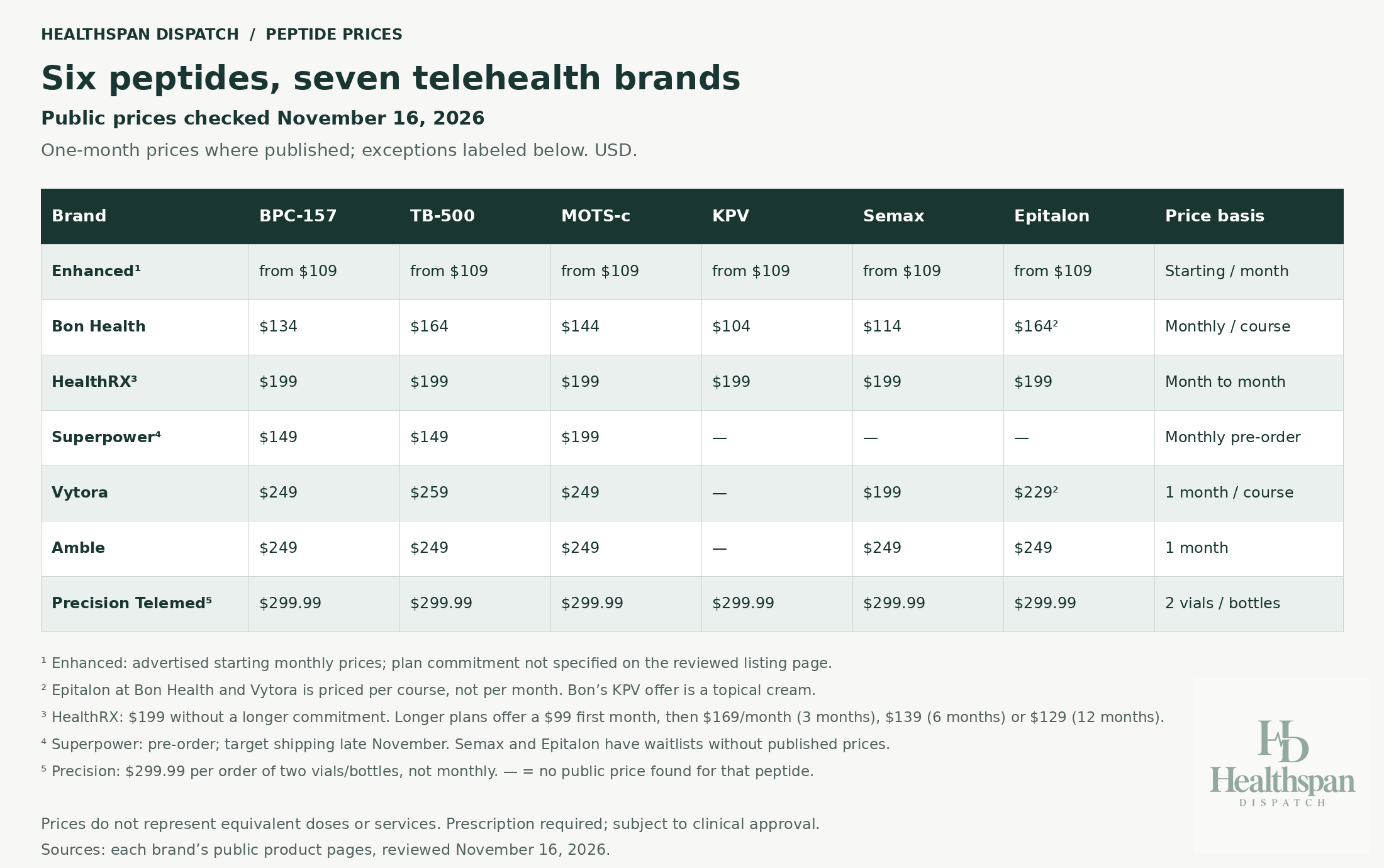
These prices don’t buy equivalent doses or services. Only HealthRX published enough information on some products to calculate a price per milligram. Patients can compare the sticker prices much more easily than what they’re getting.
Hims & Hers shares rose about 5% on Oct 28, but Andreessen Horowitz’s State of Longevity report offers a less exuberant prospect. Once everyone offers peptides, prescribing them “may matter more for keeping existing patients from leaving than for attracting new ones.” There is substantial hype in the marketplace, but the true size of the prize and value proposition to consumers is still very much in question.
FDA Listings for the Six Peptides
The policy requires the original ingredient manufacturer to be FDA-registered and meet manufacturing-quality requirements, with its physical location named on the certificate sent to the compounder. A registered intermediary can still supply the ingredient, but must validate the original manufacturer and its certificate.
Public records show registrations, product listings and enforcement history. They don’t prove sales, establish manufacturing quality or reveal the certificate supplied with a particular batch.
We pulled every FDA bulk-ingredient listing for the six peptides as of Nov 9: 59 in all. Thirteen failed our screen. Six belong to Darmerica, a US relabeler and repacker; five to SCH Global, an unregistered sourcing agent; and two to Sichuan Jisheng, a Chinese manufacturer under an import alert for refusing an FDA inspection. The relabeler’s products could still qualify if the original manufacturer meets the policy’s requirements and the intermediary performs the required validation. Its listings don’t establish that. That leaves 46 listings associated with 15 companies registered as manufacturers:
Of the 46 passing listings, 33 belong to 11 companies registered in China, eight to three companies in India, and five to one US company, Pure Peptide Pharmaceuticals.
Every KPV listing that passes the screen belongs to a company registered in China or India.
We found classified FDA inspections for two of the 15 companies: Zhejiang Wild Wind, whose inspection ended Sept 11, 2026, with No Action Indicated; and Hangzhou Hotide, whose inspection ended Aug 5, with Voluntary Action Indicated. We found no classified inspection posted for the other 13 as of Nov 9.
Pure Peptide Pharmaceuticals of Louisville, Kentucky, is the only US company in our census matched to an FDA registration that includes API manufacture. Its registration also covers relabeling and repacking; the records don’t establish where these ingredients are synthesized. We found no classified FDA inspection posted as of Nov 9.
Bachem, CordenPharma, PolyPeptide and Resilience, established peptide manufacturers with US plants, list GLP-1 ingredients such as semaglutide, liraglutide and tirzepatide with FDA, but none of the six peptides in the new policy.
Hims touts a US peptide facility, but we found no Hims listing for any of the six as of Nov 9. Its annual report, filed in February 2026, described the facility as not yet in commercial operation. On its Nov 9 earnings call, Hims said it had acquired and integrated a peptide plant in Menlo Park and plans to make BPC-157 and TB-500 ingredients there ‘when the regulatory environment permits.”
Does your supplier pass the same screen? Search the Supplier Census for its listings and the public records behind our assessment.
A US compounding address does not establish where the ingredient was made. To substantiate American sourcing, a brand needs to identify where the peptide was synthesized.
At Eudemonia, a longevity and wellness conference, the Nov 7 peptide panel was asked why it trusted pharmacies’ ingredient sourcing. Ben Greenfield, who disclosed peptide-company investments and a business connecting patients to a 503A pharmacy, answered: “ninety percent of stuff is coming from China,” most from “twelve to thirteen different labs.” Our census found 12 China-registered companies listing the six peptides; 11 passed our screen.
Drug master files contain confidential manufacturing information that can support drug applications, including clinical research. FDA does not approve the files themselves, and they don’t identify customers. Guizhou Utide and Hybio filed seven for BPC-157, TB-500, MOTS-c and KPV within nine weeks of the July advisory vote, before HHS issued its policy. A filing alone does not establish that FDA has reviewed its technical contents or verified the quality of the ingredient. These filings have been made for the six peptides named in the policy, as well as the blockbuster GLP-1 drugs sold by Eli Lilly and Novo Nordisk.
Retatrutide Master Files
An example of this master file game is happening with retatrutide. Retatrutide is Eli Lilly’s next-generation weight-loss drug, still in trials and outside the six-peptide policy. Thirteen companies, all tracing to China, have filed master files for its ingredient. Two also listed it with the FDA in early 2025, more than a year before filing. Those records establish neither sales nor who their customers might be. Lilly says it plans to submit retatrutide for US approval in the first quarter of 2027; and they are building their own manufacturing plants in the US to support the expected launch.
Harbin Jixianglong shows why a listing alone offers little reassurance. An ingredient maker in northeast China, Harbin Jixianglong was added to FDA’s GLP-1 ingredient import “green list” on September 5, 2025, based on previously supplied quality information. Two months later, inspectors found it had bought semaglutide from a plant that wasn’t on the list, labeled it as its own and changed manufacturing dates. Its semaglutide was recalled in February, FDA barred its imports on Feb 27, and a warning letter followed on May 1. Between the import ban and the letter, it filed its retatrutide master file. It had listed retatrutide with FDA in January 2025.
The other holders range from established to flagged. Hybio, founded in 1998 and listed on the Shenzhen Stock Exchange, is a mainstream peptide manufacturer. Sichuan Jisheng and Chengdu Shengnuo are both under FDA import alerts, Sichuan Jisheng for refusing an inspection.
Separate records establish sales outside approved distribution: FDA cited Darmerica’s retatrutide sales to pharmacies, and retatrutide appears in the seizure notices we reviewed. We could not establish which, if any, of the 13 master-file holders supplied those products. However, it is clear that simply being registered is quite different from having an actively audited and transparent supply chain.
While the current goal with peptide policy is to offer a clearer and safer class of product with growing demand in the American market, doing so has taken a rather unique process.
How HHS Bypassed the Usual Process
Normally, for an ingredient to be added to the list of products that are not technically approved drugs but that compounding pharmacies can sell, called the 503A Bulks List, the FDA evaluates the evidence, consults an advisory committee and uses rulemaking to decide whether to add the nominated ingredient in question. Separately, its interim enforcement policy groups nominations into three categories: Category 1 has sufficient information for evaluation without identified significant safety risks; Category 2 has identified significant safety risks; and Category 3 lacks sufficient supporting information.
Category 1 can qualify for conditional enforcement discretion while FDA evaluates the substance. It is not FDA approval or inclusion on the final bulks list. BPC-157 and several other peptides had been placed in Category 2 in 2023.
Kennedy pushed for broader access. In April, 12 peptides left Category 2 after their industry sponsor nominators withdrew them—not because new safety data had resolved FDA’s concerns. The path was being cleared for their approval from inside.
Next came FDA’s PCAC (Pharmacy Compounding Advisory Committee) advisory committee meeting, fresh off the addition of Kennedy-aligned members. FDA staff recommended against all seven peptides under review. In July, the committee recommended six anyway, with BPC-157, KPV and TB-500 each passing 8–6, contrary to FDA staff’s recommendation. The committee’s votes were advisory, not binding decisions. A coalition of physician and patient groups later pointed out that the eight panelists Kennedy had added made up the entire “yes” bloc. HHS says all members meet ethics rules.
According to AP, HHS first wanted FDA to declare the peptides safe. When that met resistance, it directed FDA not to enforce instead, and FDA helped draft the safeguards. Kennedy signed the policy; its appendix records FDA’s recommendation against all six.
HHS opened access before FDA completed its usual rulemaking. It can also withdraw that access.
What the Policy Covers - RUO vs Compounding
The policy addresses pharmacy compounding. It does not cover the direct-to-consumer mail-order market.
Through pharmacies. Raw powder enters through formal customs and goes to US compounders, who turn it into finished drugs. Failures in this route can surface in FDA warning letters or recalls.
By mail. Finished, labeled vials ship straight to consumers and resellers, often as kits with BAC mixing water included. This is typically referred to as the RUO (Research Use Only) channel because of the label these products bear. Customs sometimes catches this route. In April, CBP in Cincinnati found about 5,000 peptide parcels hidden in more than 300 master cartons. Nearly everything in the 2026 seizure notices in our 2026 Seizure Ledger was consumer-ready product, and most of the identifiable value was GLP-1 weight-loss drugs, not the six peptides.
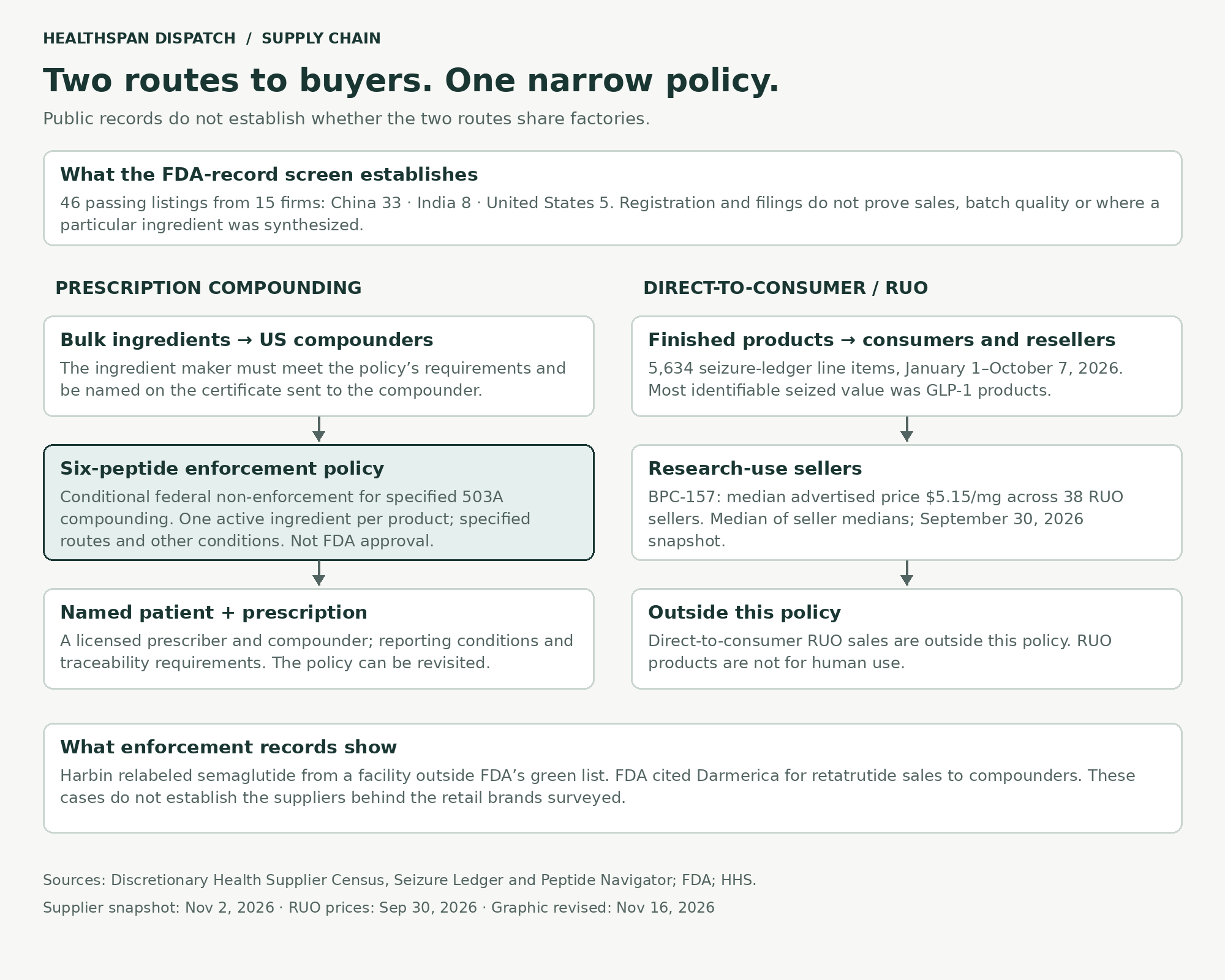
Do the two routes share factories? We checked 30 retail brands but couldn’t establish whether their ingredients came from the FDA-registered manufacturers in our census.
TRM Labs tracks more than 150 China-based chemical vendors accepting crypto; about 75% sell both peptides and fentanyl precursors. Payments to vendors confirmed to sell both rose from $28.2 million in 2023 to $37.3 million in 2025. Those are payments to the vendors, not a measure of peptide sales alone.
That overlap raises questions about whom buyers are trusting. It does not establish fentanyl contamination in peptides, it does suggest that firms that are happy to sell to cartels are now seeing profit opportunity in peptides. None of the 27 China-based firms named in the fentanyl-precursor indictments and sanctions we checked appeared in the FDA’s records; we could not connect them to the manufacturers in our census. Our review did not establish whether those vendors supply ingredients to US compounders, but it’s worth keeping in mind when considering the potential risks.
Other harm signals so far:
Poison-center exposures tied to products sold as retatrutide went from 249 in the first quarter of 2026 to 460 in the second and 862 in the third, according to America’s Poison Centers data reported by CBS News.
The FDA has received two death reports linked to products sold as retatrutide. Causation hasn’t been established.
CBS bought “retatrutide” at a Brooklyn bodega. It contained no peptide at all.
At the Eudemonia peptide panel, Matt Kaeberlein estimated that about 15% of peptides bought online carry detectable endotoxin, a bacterial contaminant that can cause severe reactions when injected, while cautioning that “there aren’t great studies on this.”
On November 12, Health Canada reported finding bacteria in an injectable peptide product seized from Sage & Summit Wellness in Ottawa. A separate November 6 advisory reported bacterial contamination in products from Shanghai ERP Peptide Biotechnology, following seizures totaling more than 11,400 vials from the supplier and two Canadian retailers.
Neither route is risk-free. “FDA-registered” does not mean FDA approved the product or inspected the plant. Harbin and Darmerica show why registration alone isn’t enough reassurance.
That’s where the policy helps. For the products it covers, it pushes quality control back up the chain: a named pharmacy, a licensed prescriber, reporting to FDA and the states, a batch that can be recalled, and the original ingredient maker named on the certificate. A mail-order seller may offer none of that accountability. When doctors prescribe unapproved peptides in clinics, they’re typically not tracking and reporting adverse events. Without consistent reporting, a dearth of reported problems tells us little about how often they occur.
But the policy-covered slice is narrow. It allows six peptides, one per product, by fixed routes, injected only with an FDA-cleared syringe. Blends, injectable KPV, pens and the GLP-1s that make up most of the money are all outside it. Buyers who want those, or who don’t want a prescriber involved, will keep ordering via shifting alternative routes.
We’ve seen short-term peptide policy before, and compounded GLP-1s show how quickly access can change. The FDA’s December 2024 tirzepatide decision and February 2025 semaglutide decision initially gave compounders 60 or 90 days, depending on facility type, before shortage-related enforcement discretion ended (See their policy decisions here). The current policy lasts until the FDA completes rulemaking on the six substances or HHS withdraws it. Businesses are building around access that could narrow or disappear.
Democrats’ congressional victories add oversight pressure. From January, they control the committees overseeing HHS and the FDA. A future HHS secretary could change course; that needn’t wait for the 2028 election.
Access to Drugs Without Approval
Retatrutide raises a potentially bigger question than any of the non-GLP peptides: what happens when buyers want a promising drug years before approval?
Answering my question at Eudemonia, Matt Kaeberlein said peptide medicines “are going to be a big part of the future,” partly because computational tools make their design easier. He carefully separated that promise from today’s experimental peptides. But more promising drugs in trials could mean more buyers unwilling to wait.
Retatrutide already has a market outside approved distribution. The six-peptide policy does not authorize it, but it shows HHS’s willingness to expand access despite the FDA reviewers’ objections. FDA has received master files for retatrutide from parties other than Eli Lilly, but those filings do not authorize commercial sales. The agency says retatrutide cannot be used in compounding under federal law and has warned telehealth marketers, ingredient distributors and outsourcing facilities against selling it, but with very little enforcement action beyond that. Lilly has separately pursued sellers through the courts with mixed success in stopping the flow.
Patents give drug developers a way to challenge unauthorized sellers, but litigation does not necessarily stop supply. Retatrutide sits outside the six-peptide policy. Its market illustrates how difficult it can be to police demand for an investigational drug before approval. An HHS decision not to enforce FDA rules for a product that is easy to make in a country that doesn’t respect IP laws and ship into the US makes it much more difficult to police.
Another new development also stands to expand consumer access to novel compounds that are not formally FDA approved: Montana removed the terminal-illness restriction from its right-to-try law in 2023 and created a licensing framework for experimental treatment centers in 2025. That expands access under state law; it does not settle the federal approval question.
I believe this pattern will repeat: promising trial results attract buyers before approval, and sellers move to meet them. It raises the question of how Washington will respond when the next one arrives.
Here’s what we’re watching:
whether the policy stays limited to six peptides;
the next advisory committee meeting, expected by February 2027, on GHK-Cu, LL-37, Dihexa, Melanotan II and PEG-MGF;
new master files for drugs still in trials;
whether other states copy Montana’s expanded right-to-try law.
What to ask
A brand could make this easier tomorrow: name the ingredient manufacturer, identify the plant and publish batch certificates. Patients could check its claims. Competitors would have to decide whether to follow.
Operators: ask your pharmacy for the ingredient maker’s name, FDA establishment number, import-alert history and a lot-level certificate, then check them against our supply-chain index. If they can’t answer, you have a vendor, not a supply chain. Plan for the policy changing.
Investors: ask whether you’re pricing a durable market or a revocable policy sitting on a mostly Chinese, mostly undisclosed supplier base.
Clinicians: ask what evidence supports the proposed use, how the pharmacy verifies the ingredient and who will report adverse events.
Patients: ask who made the ingredient, then look up the company in our Supplier Census. Use our Peptide Navigator to compare advertised prices. A higher price alone does not establish better quality.
Building a peptide, private pay health, or consumer wellness offering? Discretionary Health can show you what public records establish about your suppliers and what still needs an answer.
How we did this
Supplier data comes from FDA registration and drug-listing files extracted Nov 2, 2026, rechecked Nov 9 without changes to the census, and the FDA’s third-quarter 2026 drug master file list. We matched listing companies by name to establishment registrations; those matches do not establish which plant made a particular ingredient. Before counting the 59 listings, we excluded two labeled “Pentadecapeptide Arginate” and four identified as full-length thymosin beta-4 which are not covered by the policy. Customs figures come from CBP seizure notices published Jan 1 to Oct 7, 2026.
Passing the screen means a maker cleared every check public records allow. It does not mean FDA has inspected it, approved anything it makes, or confirmed it meets manufacturing-quality rules. Full methods are on our methodology page, and the underlying records are in our Supplier Census, 2026 Seizure Ledger, supply-chain index and Peptide Navigator.
Sources
Primary data
CBP: Cincinnati foils scheme to smuggle 5,000+ unapproved peptides
CBP forfeiture notices, 2026 (Discretionary Health extraction)
Reporting and analysis
Axios: Chinese fentanyl makers find new U.S. market in peptides
KFF Health News: Four Red Flags and One Truth Amid the Peptide Hype
DOJ fentanyl-precursor indictments, 2023–2026: June 2023, Oct 2023, Oct 2024, Sept 2025, Mar 2026
Discretionary Health